The Girl Who Built a Star
🚀
Science & Space
Maya loved space more than anything.
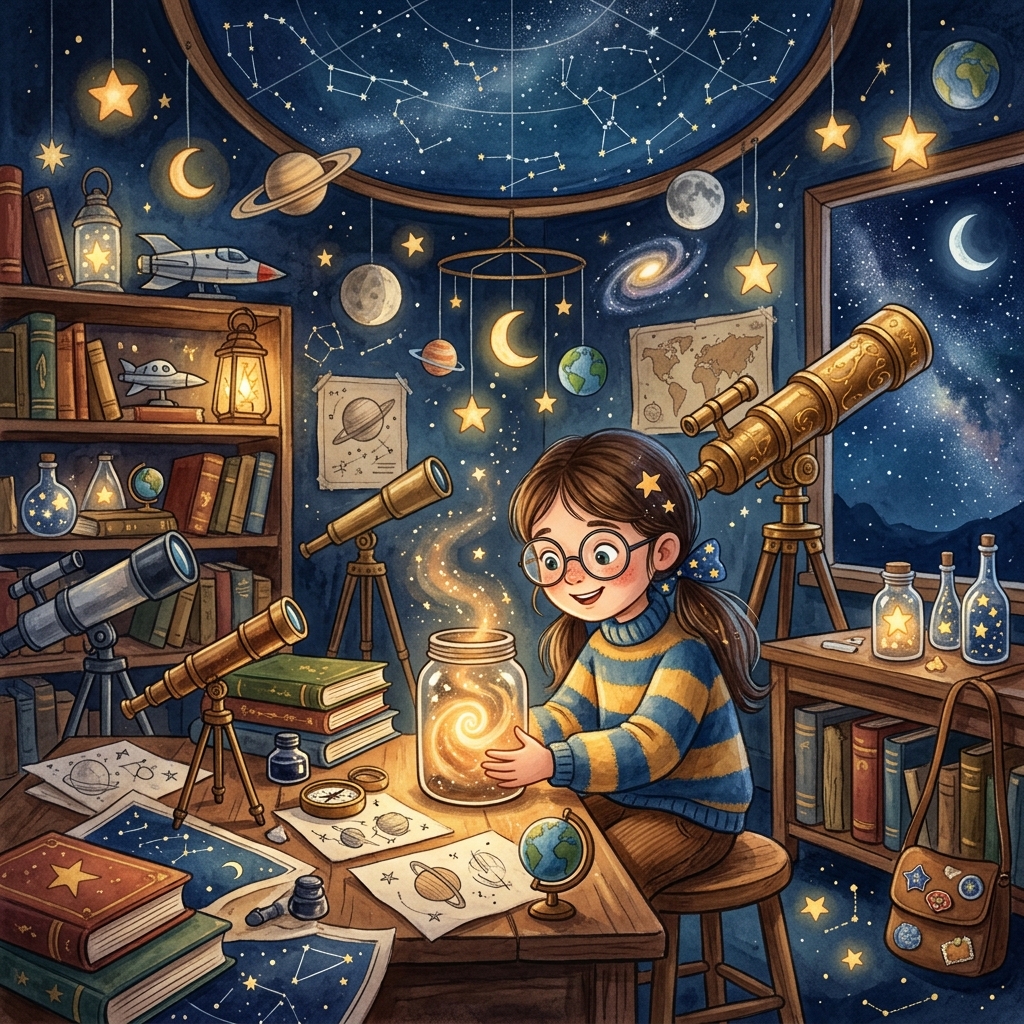
Her bedroom ceiling was covered with paintings of constellations and stars. Her shelves were filled with books about astronomy and the universe. Her favorite possession was a model of the solar system that she had built carefully with her own hands.
While some children dreamed of becoming athletes or musicians, Maya dreamed of understanding the secrets of the stars.
She wanted to know how stars were born, how they shined for millions of years, and what mysteries were hidden deep inside the universe.
One evening, Maya sat beside her telescope, observing the Orion Nebula, a giant cloud of gas and dust floating far away in space.
She looked at its beauty and imagined the countless stars forming inside it.
Maya knew that stars were enormous balls of hot gas. She knew that their energy came from a process called nuclear fusion, where hydrogen atoms combine under extreme pressure and heat to create helium and release incredible amounts of energy.
She looked at her cat, Kepler, and smiled.
"I want to build a star, Kepler," she said.
"Not a real star in the sky, but a tiny model that shows how stars work."
The next day, Maya shared her idea with her science teacher, Mr. Daniel.
He smiled and said:
"Building a real star is impossible, Maya."
"Stars need enormous gravity, extreme heat, and incredible pressure—conditions that only exist deep inside space."
"But you can create a scientific model that demonstrates some of the things that happen inside stars using electricity, magnetic fields, and light."
"It would be a wonderful science fair project."
Maya was thrilled.
She decided to create a project she called:
The Little Star Jar.
Her goal was to create a small glowing plasma model, showing one of the amazing states of matter found inside stars.
Maya began researching immediately.
She read science books, studied experiments, and filled notebooks with ideas and drawings.
With Mr. Daniel’s help, she carefully prepared her project in the school laboratory, making sure everything was handled safely.
The project required patience and careful adjustments.
During her first attempt, Maya connected the parts, turned on the system, and waited.
Nothing happened.
The jar remained dark.
Maya looked at it and said:
"Something is not working yet."
Instead of giving up, she searched for the problem.
She checked every connection and tested each part.
She discovered that air was entering the jar, preventing the plasma effect from forming.
She fixed the problem and tried again.
But the second attempt failed too.
This time, a small spark appeared, and the system shut down.
Mr. Daniel helped her find the mistake.
"The problem is not your idea, Maya," he said.
"Science is not about succeeding on the first try."
"Every failed experiment teaches us something important."
Maya repaired the design once again.
She adjusted the parts more carefully and checked every detail.
Although she felt frustrated, she remembered her teacher’s words:
"Science is not about having the answer immediately."
"Science is about learning from every attempt."
On the third day, Maya was ready to try again.
She made the final adjustments.
She checked everything one more time.
Then she turned on the machine.
At first, nothing happened.
Maya held her breath.
Then suddenly...
A soft purple glow appeared inside the jar.
The light slowly grew brighter and gathered around the center.
A tiny ball of glowing plasma appeared, shining with beautiful shades of pink and blue.
It looked like a miniature star floating inside the jar.
Its gentle light spread across the walls of the laboratory.
Maya stared in amazement.
"It worked!"
"It is not a real star, but it helps us understand the science behind stars."
It was one of the happiest moments of her life.
Maya brought her project to the school science fair.
Standing in front of students and teachers, she explained how stars are born.
She talked about gravity, nuclear fusion, plasma, and how energy inside stars travels across millions of miles to reach us as light.
She also explained that her model did not create real nuclear fusion, but it helped demonstrate some scientific ideas in a simple and exciting way.
The judges were impressed by her understanding, creativity, and determination.
They admired how she solved problems instead of giving up.
Maya won first prize.
But to her, the greatest reward was the tiny glowing star inside her jar.
She had proven that curiosity, patience, and the courage to learn from mistakes could open the doors to incredible discoveries.
After that, Maya began helping younger students create their own science projects.
She wrote a small booklet called:
"Maya’s Guide to the Stars."
Inside, she explained how stars are born, how they live, and how they eventually transform through incredible events like supernovas and black holes.
She made the explanations simple and exciting, inspiring her friends to learn more about space.
The school science club grew bigger every month.
Students began creating models of galaxies, rockets, and space exploration vehicles.
Maya’s passion for the universe had inspired the entire school.
She showed everyone that science was not just a subject in a classroom.
It was a window into the wonders of the cosmos.
Every night, Maya sat beneath the starry sky and looked at the distant lights above.
She knew her journey would include challenges and difficult moments.
But she was no longer afraid of mistakes.
She understood that every mistake carried a lesson, and every attempt brought her one step closer to discovery.
In her room, the Little Star Jar continued to glow with a soft pink and blue light.
It reminded her every day that the greatest discoveries often begin with a simple question.
Goodnight, little dreamers.
Keep asking questions.
Learn from every mistake.
And let your curiosity shine brightly, like a tiny star lighting the endless sky.