
Leo and the Secret of the Stars
🚀
Science & Space
Leo loved looking at the night sky.
While other children dreamed of adventures on Earth, Leo dreamed of exploring the universe. He was a member of the local astronomy club, and his greatest wish was to discover something in the sky that no one had ever noticed before.
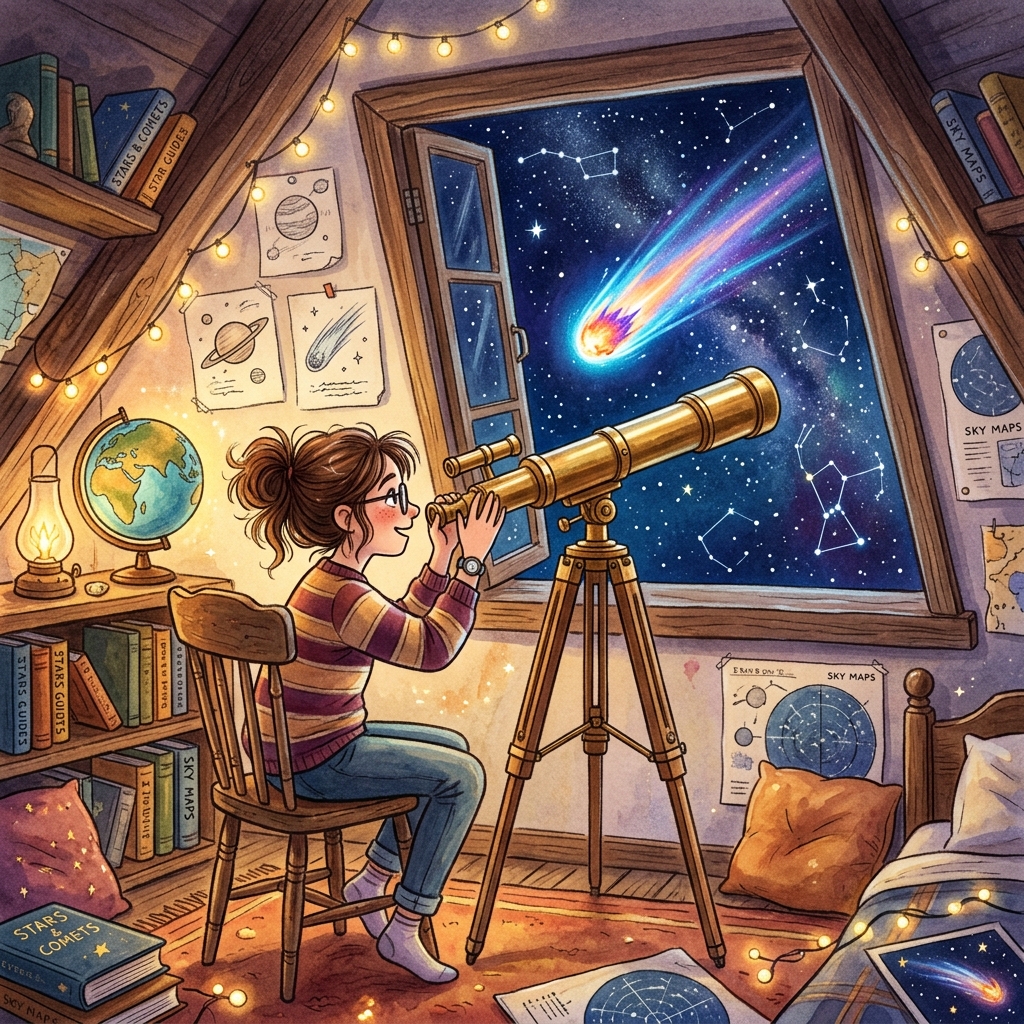
Every evening, he climbed the stairs to his attic room, where an old brass telescope stood beside the window.
The telescope had once belonged to his great-uncle, who had also loved studying the stars.
With his telescope, Leo watched the planets move across the sky.
He carefully recorded his observations in a journal, drawing maps of Mars, studying Saturn’s beautiful rings, and tracking the changing phases of Venus.
To Leo, every star was a mystery waiting to be discovered.
One evening, while reading an astronomy magazine, Leo found exciting news.
A rare comet called Comet Zephyr was expected to pass close to Earth in just three weeks.
The comet appeared only once every seventy-five years, making it a once-in-a-lifetime opportunity.
The article explained that the comet would be visible in the northern sky, but only during a short three-night period.
Leo’s eyes widened with excitement.
"I have to find it," he said.
"I want to calculate its path and capture a picture of its glowing tail."
His older cousin Sarah, who was studying engineering at university, offered to help him.
"Finding a comet requires careful calculations, Leo," she explained.
"You need to understand where the comet will be in the sky based on its speed, Earth's movement, and many other details."
"Even a tiny mistake could make your telescope point in the wrong direction."
Leo smiled.
"Then I’ll make sure my calculations are correct."
For the next two weeks, Leo worked harder than ever.
He studied how objects move through space, practiced using star coordinates, and filled pages of his notebook with equations and drawings.
He used a computer program to predict the comet’s path and compared the results with his own calculations.
Finally, the first night of the comet’s arrival came.
The sky was clear and filled with thousands of stars.
Leo carried his telescope to the roof, carefully adjusted the equipment, and entered the coordinates he had calculated.
He looked through the telescope.
Nothing.
Only the familiar stars of the night sky appeared.
He searched slowly, moving the telescope from side to side.
But the comet was nowhere to be seen.
Leo lowered his head.
"I must have made a mistake," he said quietly, looking at his notebook.
Sarah sat beside him and examined his calculations.
"Wait, Leo," she said.
"I think I found the problem."
"You treated Earth's speed around the sun as if it stayed exactly the same."
"But Earth's orbit is slightly curved, which means its speed changes during the year."
"You only missed a small adjustment."
Leo looked closely at the numbers.
She was right.
It was a tiny mistake, but when searching for something millions of miles away, even the smallest error could change everything.
Leo sighed.
"I failed."
Sarah smiled.
"No, Leo. You learned something."
"In science, finding a mistake is part of discovering the truth."
"Scientists do not succeed because they never make errors. They succeed because they learn from them and try again."
"The difference between someone who dreams and someone who discovers is the courage to keep searching."
"We still have two more nights."
"Let's recalculate."
Leo felt hopeful again.
The next day, he carefully reviewed every calculation.
With Sarah’s help, he corrected the mistake and adjusted the numbers.
He checked the telescope settings, studied the atmosphere’s effect on light, and made sure the location of their town was included perfectly.
On the second night, thin clouds covered the sky.
Leo waited patiently on the rooftop.
He watched the clouds drift slowly past the stars.
Then, just before midnight, the clouds separated, revealing a clear view of the northern sky.
Leo carefully entered the new coordinates.
He took a slow breath.
He looked through the telescope.
For a moment, he said nothing.
Then his eyes widened.
"I see it!"
In the center of the telescope’s view was a beautiful glowing comet.
Its bright center shone like a tiny diamond, and its long sparkling tail stretched across the darkness of space.
Silver and green colors shimmered among the stars.
It was Comet Zephyr, traveling silently through the universe.
"Sarah, look!" Leo said excitedly.
"It's beautiful!"
Sarah looked through the telescope and smiled.
"You found it, Leo."
"Your calculations worked."
Leo carefully connected his camera to the telescope and captured a photograph of the comet.
The image showed the glowing center and the delicate patterns of its shining tail.
He recorded the exact location and details of his discovery, then shared his observation with an astronomy organization.
For Leo, that night became unforgettable.
He learned that science was not about being perfect.
It was about curiosity, patience, and the courage to continue searching.
Mistakes were not walls blocking the way.
They were signs showing him where to look next.
Leo knew the universe was enormous and filled with countless mysteries.
But he also knew that with dedication and a love for learning, he could uncover some of its secrets.
That night, he fell asleep dreaming of distant galaxies, mysterious planets, and new worlds waiting to be discovered.
As the years passed, Leo continued studying the stars.
He shared his knowledge with younger students, teaching them how to use telescopes and explore the wonders of space.
He kept his journal close, always ready to record new discoveries about planets, stars, and distant galaxies.
Leo understood that a true astronomer is not someone who never makes mistakes.
A true astronomer is someone who keeps learning, keeps searching, and keeps looking toward the stars.
The night sky remained full of mysteries.
And Leo was always ready for the next adventure.
Goodnight, little dreamers.
Keep asking questions.
Keep learning.
And remember: every mistake is another step closer to discovering something amazing.