
👁️🗨️🌌 The Black Hole That Tried to Speak
🚀
Science & Space
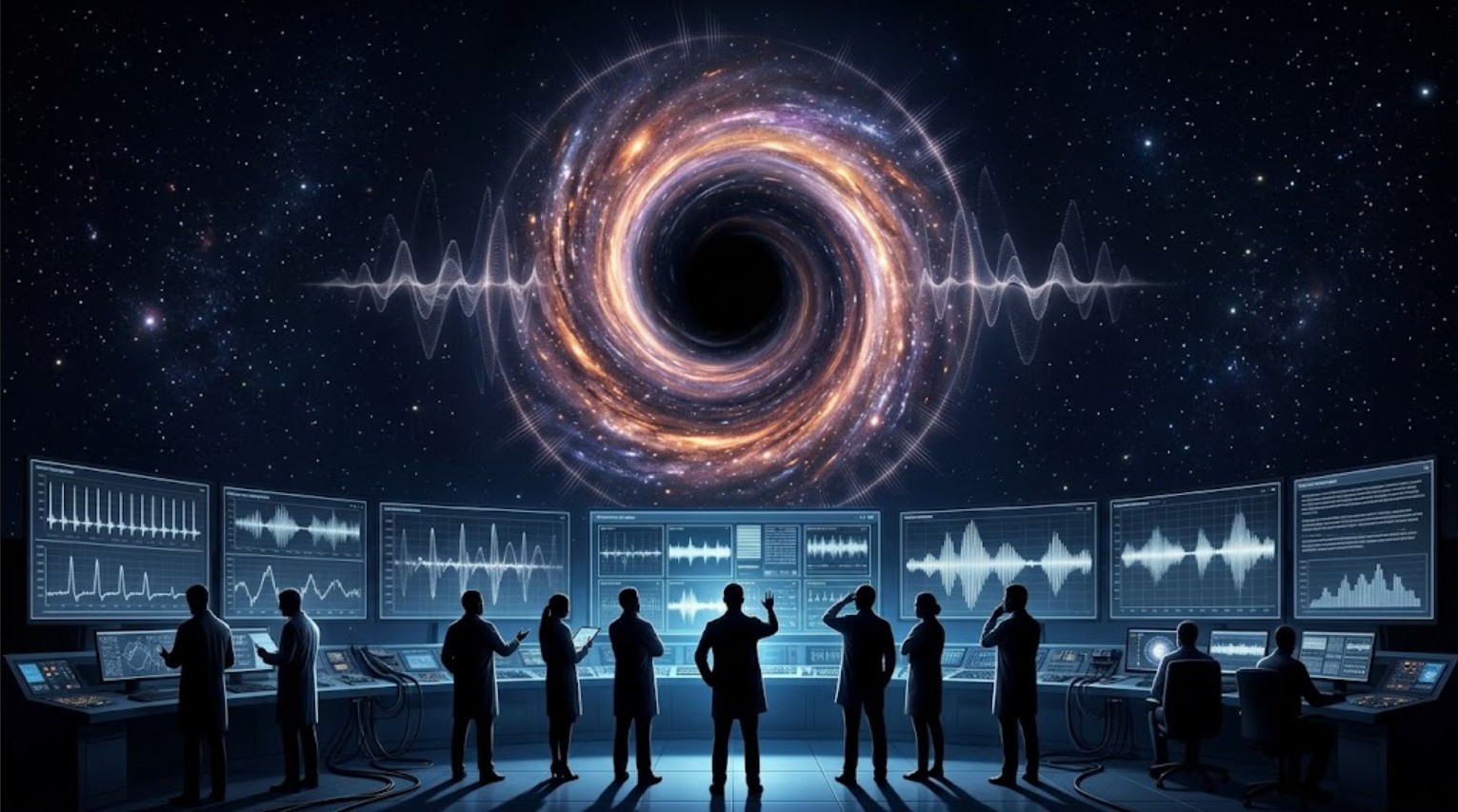
A colossal black hole, larger than millions of suns combined, slowly turned at the heart of a distant galaxy billions of light-years from Earth. Around it, stars moved in silence, while rivers of burning gas spiraled toward the darkness, creating a vast luminous vortex.
From a distance, it looked like a giant black eye staring into the universe.
No one knew what happened inside that darkness.
Until that night.
At a space observatory far beyond the noise of Earth, a team of scientists was conducting what was supposed to be a routine observation. The mission was nearly over. The screens were filled with numbers, graphs, and faint signals.
Nothing unusual.
Then everything changed.
A signal appeared.
One line on the screen.
Then another.
Then a sequence of perfectly spaced pulses.
The scientists stopped talking.
"Run the scan again," Layan whispered.
They did.
The result was identical.
The signal wasn't coming from a star.
It wasn't coming from a planet.
It wasn't coming from a cloud of gas.
It was coming from the black hole.
At first, they assumed the instruments had detected interference. Perhaps a malfunction. Perhaps some unknown source of radio noise.
But the signal continued.
Weak.
Deep.
Rhythmic.
Almost deliberate.
The team began recording it.
Then someone suggested something that would change everything.
They converted the frequencies into sounds that human ears could hear.
The lights in the control room were dimmed.
The scientists gathered around the speakers.
For a moment, there was complete silence.
Then Layan pressed the button.
A sound emerged.
One note.
Deep.
So deep that they felt the vibration in their chests before they truly heard it.
Then came a second note.
Then a third.
The sound slowly rose and fell, moving through the room like the distant voice of something impossibly large.
No one spoke.
It didn't sound like an explosion.
It didn't sound like cosmic radiation.
It sounded like music.
A beautiful, slow, haunting song.
One of the scientists finally whispered:
"This is impossible."
But no one answered him.
They were listening.
And with every repetition, the pattern became clearer.
There were pauses.
Repeating sequences.
Subtle changes in rhythm.
The signal wasn't random.
It was structured.
It was almost as if something was trying to speak.
Days became weeks.
The team barely left the laboratory.
They compared the frequencies with the movements of ancient stars, the rotation of the galaxy, the motion of massive clouds of gas, and the history of gravitational disturbances.
And then they found something terrifying.
The song was telling the history of the galaxy.
The first note corresponded with the birth of some of its earliest stars.
The second appeared during the formation of enormous clouds of gas.
Another sequence matched the moment when smaller galaxies collided with the young galaxy surrounding the black hole.
Every sound corresponded to an event.
Every vibration marked a moment in time.
The scientists stared at the data in disbelief.
The black hole wasn't singing about itself.
It was singing about everything that had happened around it.
It was recording time.
It was preserving memories of the universe.
The head of the research team leaned toward the screen.
"We aren't listening to a sound from the past," he said.
He paused.
"We're listening to the past itself."
Then one of the monitors went dark.
Another followed.
Then another.
Only one screen remained illuminated.
A new pattern had appeared.
It wasn't part of any previous recording.
The song began again.
But this time, it was different.
Slower.
Clearer.
Closer.
Layan stared at the waveform.
"Was this in the original recording?"
A scientist shook his head.
"No."
"Then when did it happen?"
He looked at the timestamp.
His face went pale.
"Now."
No one moved.
They checked the instruments again.
The signal was coming from the black hole at that exact moment.
The black hole was sending something new.
Something that was happening in real time.
The head of the team slowly raised his eyes.
"Play it."
No one moved.
Then Layan pressed the button.
The sound filled the room.
This time, it wasn't merely music.
There was a pattern.
One pulse.
Silence.
One pulse.
Silence.
Then three pulses in rapid succession.
The scientists watched as the waveform appeared on the screen.
One of them suddenly stopped breathing.
"It's repeating."
"What does it mean?"
He didn't answer.
He began calculating the intervals between the pulses.
Then he calculated them again.
And again.
Finally, he looked up.
His voice was trembling.
"It's not random."
The others moved closer.
"Then what is it?"
He stared at the screen.
"It's a message."
At that exact moment, the final note sounded.
Then everything went silent.
On the screen, a single sequence of numbers appeared.
Coordinates.
A location in space.
A place humanity had never observed before.
The scientists stared at it in silence.
Then the observatory detected another signal.
And another.
Then thousands more.
Across the galaxy, distant objects had begun transmitting the same strange frequencies.
Stars.
Gas clouds.
Black holes.
All singing the same song.
The head of the team slowly looked toward the window, even though there was nothing to see beyond the darkness.
"Maybe the black hole wasn't singing," he whispered.
He paused.
"Maybe it was trying to wake us."
Far away, at the edge of a galaxy no human had ever visited, the song continued.
A song of gravity and time.
A song that had begun billions of years before humanity existed.
A song that had witnessed the birth of stars...
the formation of galaxies...
the rise and disappearance of worlds...
and perhaps, the birth of humanity itself.
And now...
it was waiting for an answer.